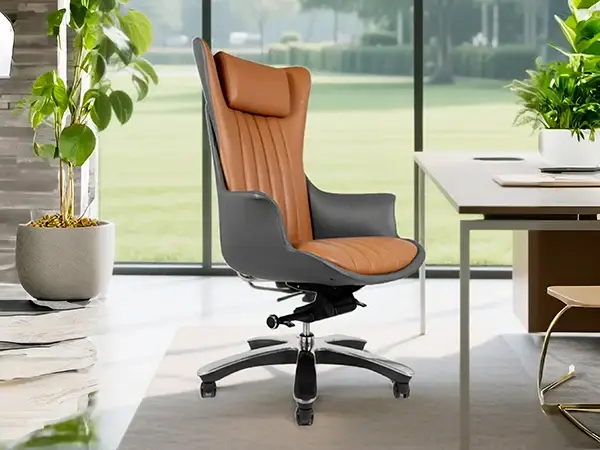
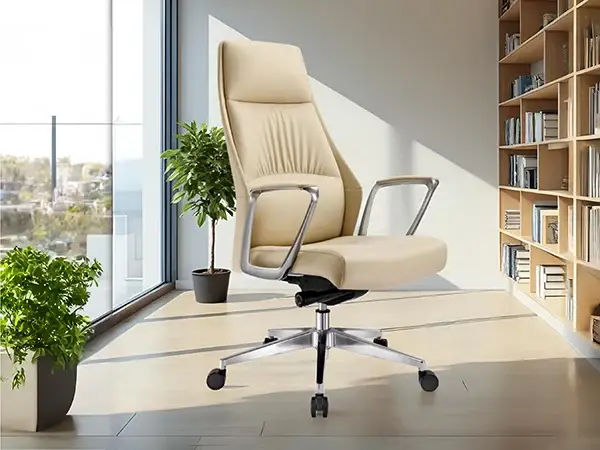
The traditional executive chair—massive, leather-clad, and static—has dominated corner offices for decades. But the professional landscape has changed, and executive seating must evolve to match.
Today’s executives don’t just preside over meetings; they code, create, collaborate across time zones, and often work from multiple locations. Their chairs must support this diversity of activities while maintaining the authority and presence the role demands.
Welcome to the evolved executive chair for 2026 and beyond.
The Old Paradigm vs. The New Reality
Traditional Executive Chair Modern Executive Chair
Static posture assumed Dynamic movement supported
One-size-fits-all Fully adjustable to individual
Aesthetic prioritized over ergonomics Aesthetic AND ergonomics integrated
Fixed position Multiple recline and work modes
Single material (leather) Material combinations for performance
Heavy, immobile Engineered for easy movement
Replacement in 5-7 years Built for decades
Feature 1: Advanced Ergonomics Beneath the Surface
The most significant evolution in executive seating is invisible: what’s happening underneath the leather. Modern executive chairs are engineered with sophisticated ergonomic features that would have seemed impossible a generation ago.
“A mistake I often see is people assuming a beautiful chair can’t also be supportive,” notes the Eureka Ergonomic team. “In the past, you might have had to choose between an ergonomic chair that looked out of place in an executive office and a stylish one that offered little support. Today, that compromise is no longer necessary” -2.
Key Ergonomic Features
Self-adapting headrests: Headrests that automatically adjust to support the cervical spine as you recline, rather than requiring manual repositioning.
4D armrests: Armrests adjustable in height, width, depth, and angle, allowing perfect positioning for any task.
Adjustable seat depth: The ability to slide the seat pan forward or back ensures proper thigh support for any leg length.
Synchro-tilt mechanisms: Coordinated movement of seat and backrest maintains proper ergonomics throughout the recline range.
Multi-point lumbar adjustment: Some chairs now offer lumbar support adjustable not just in/out, but up/down and even side-to-side for personalized spinal support.
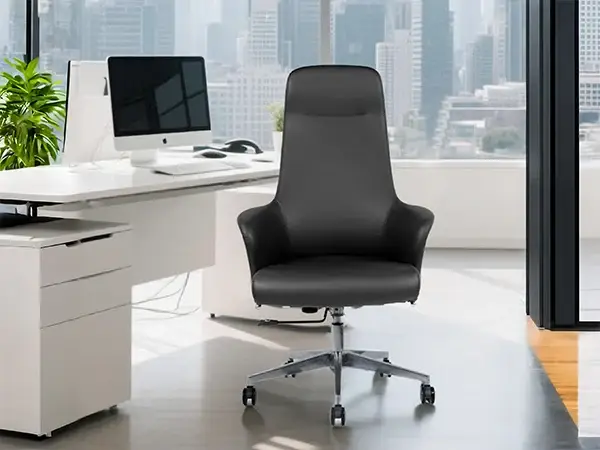
The Forma ergonomic executive chair “features a self-adapting headrest, 4D armrests, and adjustable seat depth, all wrapped in a sleek PU leather finish. Its signature aluminum alloy back frame provides stable lumbar support that holds its position even when you recline”.
Feature 2: Intelligent Material Combinations
Modern executive chairs recognize that no single material is perfect for every application. Instead, they combine materials strategically:
Leather where it matters: High-wear areas like the seat and armrests benefit from leather’s durability and ease of cleaning.
Mesh for breathability: Backrests in breathable mesh keep executives cool during long work sessions.
Memory foam for pressure relief: Advanced foam formulations conform to body shape while maintaining support.
Aluminum for structure: Lightweight, strong frames reduce overall chair weight while maintaining durability.
This hybrid approach “offers the luxury of leather where you sit and the breathability of mesh along the spine, maximizing both comfort and style”.
Feature 3: Technology Integration
The executive chair is becoming a connected device, integrating with the broader smart office ecosystem.
Sitting sensors: Monitor time in position and suggest movement breaks.
Posture feedback: Provide gentle reminders when slouching exceeds preset parameters.
Preset memory: Remember preferred positions for different users or activities.
Health integration: Sync with wearables to optimize work sessions based on energy levels and activity patterns.
Wireless charging: Built-in charging pads for devices kept within reach.
Feature 4: Multiple Work Modes
Today’s executives perform diverse tasks, each benefiting from different seating positions:
Focus mode: Upright position with firm lumbar support for intensive computer work.
Collaboration mode: Slightly open angle that invites conversation while maintaining engagement.
Thinking mode: Reclined position with head and neck support for reflection and contemplation.
Active mode: Perched position on the chair’s front edge for high-energy discussions or phone calls.
Modern chairs support seamless transitions between these modes with intuitive controls and smooth mechanisms.
Feature 5: Aesthetic Evolution
Executive chairs haven’t abandoned aesthetics—they’ve refined them. The evolved executive chair offers:
Slimmer profiles: Advanced materials allow comfortable support with less visual bulk.
Cleaner lines: Modern design language favors simplicity over ornamentation.
Material variety: Combinations of leather, metal, and wood create visual interest.
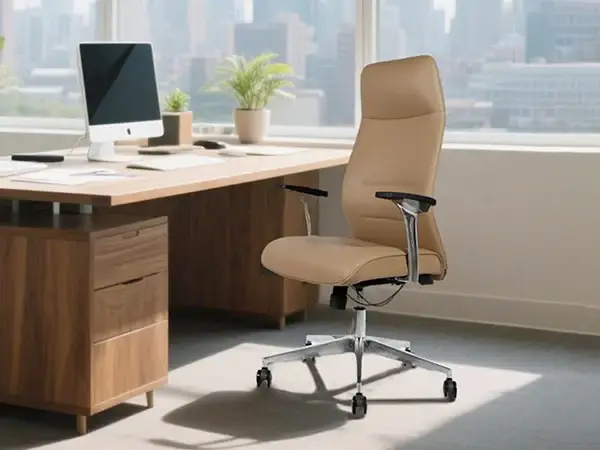
Color options: Beyond black and brown, executive chairs now appear in charcoal, navy, cream, and even bolder choices.
Refined details: Polished aluminum bases, precision stitching, and thoughtful proportions signal quality without shouting.
The Nox genuine leather executive chair “combines leather with a sleek metal frame, making it a perfect match for contemporary desks with glass or metallic elements”.
Feature 6: Sustainability Engineering
Environmental responsibility has become an executive priority, and chairs reflect this shift:
Responsible materials: Leather from tanneries using chrome-free processes, recycled metals, and sustainable textiles.
Circular design: Chairs designed for disassembly, allowing component replacement and end-of-life material recovery.
Carbon accounting: Manufacturers tracking and offsetting production emissions.
Durability focus: Building chairs that last decades reduces replacement frequency and environmental impact.
The Pony Saddle exemplifies this approach: “Each Pony Saddle chair produced leaves the world better off by positively impacting energy, water, and carbon in the environment”.
Feature 7: Size Inclusivity
Historically, “executive” often meant “large”—designed for the 50th percentile male body. Modern executive chairs accommodate the full range of human diversity:
Extended height ranges: Accommodating users from the 5th to 95th percentile.
Weight capacity options: Models supporting up to 150kg or more.
Adjustability for all: Controls designed to be operable by users of any strength or dexterity.
Gender-inclusive design: Recognizing that body proportions vary independently of height.
Feature 8: Enhanced Durability
Modern executive chairs are built to last, with testing protocols that simulate decades of use:
100,000-cycle mechanism testing: Simulating years of recline use -4.
Load testing: Confirming stability and safety at maximum rated weights.
Material testing: Abrasion, UV, and stain resistance verified.
Component replaceability: Key parts designed for replacement when (not if) they eventually wear.
Feature 9: Easy Assembly and Disassembly
As work becomes more mobile, chairs must move more easily:
Tool-free assembly: Components that click together without specialized tools.
Compact shipping: Designs that pack efficiently for reduced shipping impact.
Easy disassembly: For office moves or recycling at end of life.
Flat-pack options: Allowing easier transport through standard doorways and stairwells.
Feature 10: Health and Wellness Focus
The evolved executive chair actively contributes to occupant health:
Movement encouragement: Designs that make position changes effortless.
Pressure mapping: Seats engineered to minimize pressure points.
Thermal regulation: Materials that manage temperature and humidity.
Posture support: Maintaining neutral alignment throughout the workday.
The 2026 Executive Chair Checklist
When evaluating executive chairs for your office, use this checklist:
- Does the chair offer adjustable lumbar support (height and depth)?
- Are armrests adjustable in at least 3 dimensions?
- Can seat depth be adjusted to match your leg length?
- Does the headrest adjust to support your cervical spine?
- Are materials appropriate for your climate and usage patterns?
- Does the chair accommodate your height and weight?
- Are controls intuitive and easy to operate?
- Is the chair built to commercial-grade durability standards?
- Does it support the range of tasks you perform daily?
- Does it reflect your professional image appropriately?
Experience the Evolution
Explore our collection of modern executive chairs, designed for the way professionals work today.
[View Executive Collection] → [Compare Chair Features]